Chosen purpose
There is no divine assignment. But a person can choose something meaningful, Make a purpose not to feel like you lived a worthless life when breathing your last breath.
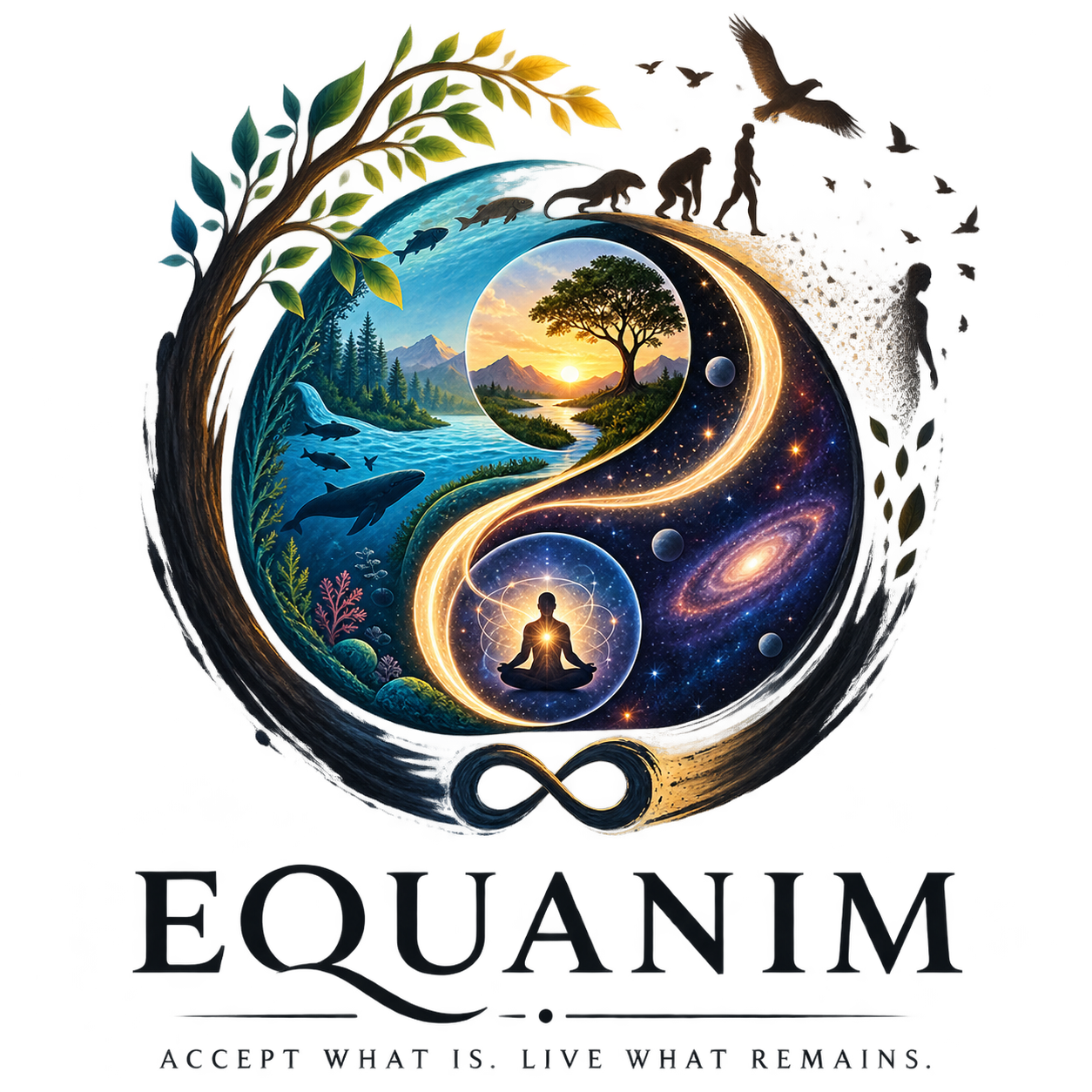
Accept What Is. Live What Remains.
Equanim is a philosophy of acceptance, awareness, detachment, compassion, and living meaningfully within an existence without predetermined purpose.
A philosophy conceived by Ganesh Acharya, Baglung, Nepal.
Not commandments. Equanim is a still-developing set of practices for meeting existence with less resistance and more honesty.
The goal is not to suppress emotion, but to recognize it without letting it fully control your actions.
Learning to release attachment matters, but letting go does not mean becoming emotionless.
You can genuinely love and care for someone while accepting they are an independent being who cannot be permanently held.
Cultivate compassion, renunciation, and non-harmful intention towards all beings. Actions rooted in greed, hatred, or delusion generate suffering.
Choose means of living that do not cause unnecessary suffering to others.
Suffering is unavoidable, so allow yourself genuine happiness and enjoyment along the way.
Do good for others. Avoid the intention to make someone suffer.
You will suffer anyway. So don't forget to live.
Because suffering can never fully disappear, Equanim does not ask for a joyless life. Treat yourself genuinely. Since suffering is unavoidable, allow yourself things that genuinely make you happy.
Convenience is the death of gratitude.
When everything is made easy, people stop noticing what they have. Gratitude asks for awareness of what you currently possess and what you currently experience.
Equanim is non-theistic. There is no god and no creator governing the universe. Nature itself is the force through which existence operates. In this philosophy's current view, existence has always been, without a supernatural beginning.
Equanim rejects a creator god, supernatural miracles, and divine intervention. It also does not currently accept the Big Bang as the beginning of everything. It holds, instead, that nature has always existed. This is offered as philosophy, not as settled science.
Humans are one part of nature's evolution, temporary characters within an enormous process, not its center or purpose. Other creatures have dominated before. Humanity may eventually be replaced by another form of life as nature continues. Humans tend to imagine themselves as the culmination of nature; Equanim rejects this.
Humans are also self-centered, and often create, manipulate, and modify beliefs to survive, justify themselves, protect themselves, or feel superior to others. Human belief, including Equanim's own, should not automatically be treated as objective or ultimate truth.
"Energy can neither be created nor destroyed, but can be transferred from one thing to another."
Equanim distinguishes between the soul, understood as spiritual energy, and the biological shell: the body and brain through which that energy currently experiences existence. The soul/spiritual energy transfers from one living thing to another, and the shell changes completely with a new brain, body, identity, etc. Within this worldview, it transfers from one living being to another, but the new being carries a new body, a new brain, and a new identity. The personality, memories, and identity you call "you" belong to this shell, not necessarily to the energy that continues. This is a metaphysical belief, not a scientific claim.
Humans continually search for an ultimate truth. Equanim questions whether one even exists. It suggests that a life spent searching for a final truth may be searching for something that was never there.
Everyone is bound by something: something to prove, to accomplish, or to obtain; by responsibility, expectation, fear, circumstance, relationship, or survival. Even the choices that feel most free exist within causes and constraints. Equanim offers this as its philosophical position, not as established science.
A central foundation of Equanim describes the mechanism behind much of human suffering, a chain that begins with attachment.
Clinging to people, outcomes, identities, or ideas as though they were permanent. Attachment is the root from which the rest of the chain grows.
Human existence has no cosmic mission attached to it. The soul experiences life through its current shell, and nothing more is promised, but if you want a purpose, you can create one.
There is no divine assignment. But a person can choose something meaningful, Make a purpose not to feel like you lived a worthless life when breathing your last breath.
Equanim believes there is no god, but it does not ask anyone to abandon belief in one. People can have faith in God for hope of a better future, fulfillment of wishes, or hope that things will become better, belief in God can still have real value to the person who holds it.
You are never good in everyone's perspective like never but also you will always have reasoning for your doing to make you not look bad. Still, Equanim recognizes good: helping those in need, doing good for others, compassion, and avoiding the intention to make someone suffer.
Followers can keep the holidays and cultural traditions of the country and culture they already live in. Equanim does not require its own calendar.
A person's value is not their money, their achievements, or their usefulness.
Equanim considers love, affection, and genuine care to be what can make someone truly valuable. A person can have nothing material to offer and still be immensely valuable, if someone genuinely loves and cares for them.
A few direct answers to questions about nature, desire, and the responsibilities that come with human intelligence.
Equanim holds that humans are naturally adapted to consume animal foods, as part of the biological conditions in which our species developed. The later inclusion and exploration of legumes, grains, vegetables, and other plant foods expanded the human diet. Choosing what to eat should still involve awareness, responsibility, and consideration for unnecessary harm.
Yes. Sexual reproduction is a natural biological function, and intimacy can also express affection, connection, and love. However, every sexual act must be grounded in clear, informed, and freely given consent. Human intelligence creates a special responsibility to distinguish what is ethical from what is harmful, and to respect another person's boundaries at all times.
Yes. Equanim has no reason to prohibit tattoos or piercings. They are matters of personal expression and individual choice, provided they are pursued responsibly and with respect for one's own health and well-being.
Ganesh Acharya, of Baglung, Nepal, conceived this philosophy. He is a human being, not an infallible prophet, a divine messenger, or an unquestionable authority.
He can make irrational arguments, misunderstand something, contradict the philosophy, fail to follow it perfectly, or change his beliefs. The philosophy is separate from its founder. He is not the authority on ultimate truth simply because he founded it. Followers can criticize him, disagree with him, and question the philosophy itself.
If scientific evidence contradicts something Equanim currently holds, the answer is to question it, investigate it, reconsider it, and change the belief if necessary. Scientific claims, philosophical claims, and metaphysical beliefs are kept distinct throughout this site.
There are simply believers who find value in the philosophy. Anyone can leave, at any time, without punishment.
Equanim is built on the belief that everything can be questioned. If you have something to challenge, discuss, or contribute, reach out.